
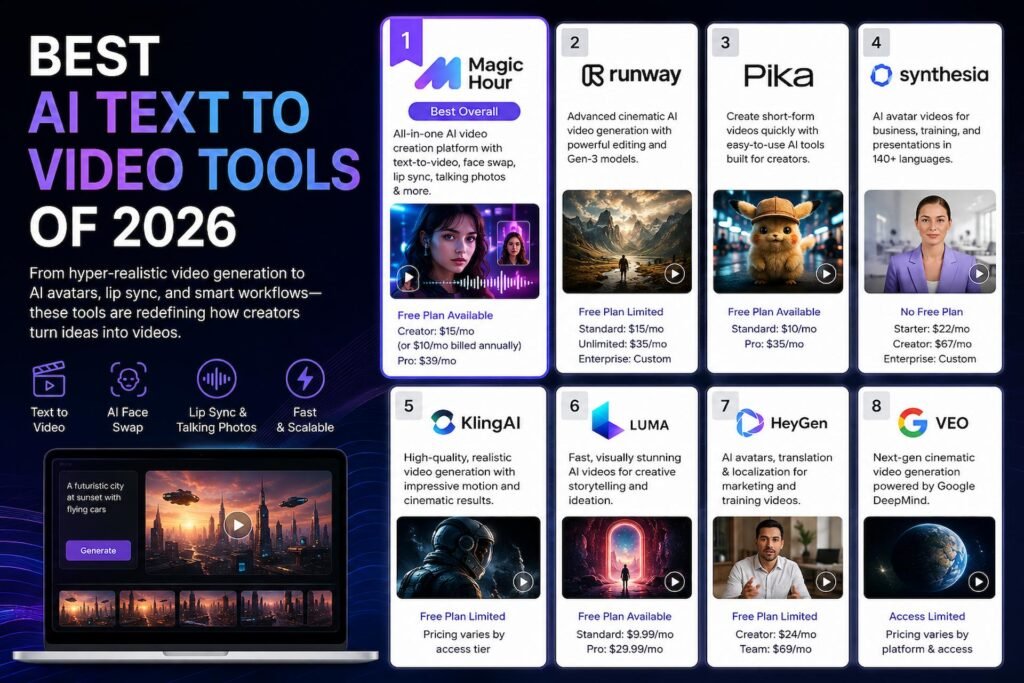
AI video generation moved from experimental novelty to practical production infrastructure surprisingly fast. As of 2026, creators are using AI tools to generate ads, short films, social clips, educational videos, product demos, and even fully animated storytelling workflows in minutes instead of days.
After testing the leading platforms over several weeks, one thing became clear: the best tools are no longer just about generating video. The winners now combine editing, automation, templates, lip sync, face swap, workflow speed, and reliable rendering under pressure.
If you are evaluating the best AI text-to-video tools in 2026, this guide breaks down the platforms that actually deliver for creators, marketers, agencies, and startup teams.
And yes — I guarantee at least one of these tools will fit your workflow.
Best AI Text to Video Tools at a Glance
| Tool | Best For | Key Modalities | Free Plan | Platforms | Starting Price |
| Magic Hour | End-to-end creator workflows | Text-to-video, face swap, lip sync, talking photos | Yes | Web, mobile | Free / $15 month |
| Runway | Cinematic AI video generation | Gen-3 video generation, editing | Limited | Web | $15 month |
| Pika | Social-first AI clips | Short-form generation | Yes | Web | $10 month |
| Synthesia | AI avatar business videos | Talking avatars, presentations | No free tier | Web | $22 month |
| Kling AI | Realistic motion rendering | Cinematic generation | Limited | Web | Variable |
| Luma AI | Fast visual storytelling | Dream Machine video generation | Yes | Web | $9.99 month |
| HeyGen | Marketing and training videos | AI presenters and dubbing | Limited | Web | $24 month |
| Veo-powered tools | Experimental cinematic output | High-end scene generation | Limited access | Web/API | Variable |
1. Magic Hour
When I tested these platforms side by side, Magic Hour consistently delivered the most balanced experience for actual production workflows.
A lot of AI video tools excel in one narrow category. Some generate impressive visuals but fail at editing. Others handle avatars well but lack creative flexibility. Magic Hour stands out because it combines multiple creator workflows into one cohesive platform without making the experience complicated.
Its biggest strength is workflow efficiency. You can generate a scene, upscale it, animate it, lip sync it, and create variations without constantly switching tools.
The platform also includes one of the strongest implementations of AI face swap technology currently available for creators working with branded content, entertainment assets, or social campaigns.
For creators focused on generation workflows, the AI text to video generator is particularly strong because it balances speed, consistency, and prompt adherence better than many competitors.
Another detail that impressed me: you can test features without creating an account. That sounds minor, but for busy creators evaluating multiple platforms, friction matters.
Pros
- Excellent text-to-video quality
- Best-in-class face swap and lip sync tools
- Talking photos work surprisingly well
- Credits never expire
- No signup required for testing
- Strong free tier
- Parallel generations without strict concurrency limits
- Frequent feature releases
- Full API parity across tools
- Mobile and desktop optimized
- Reliable under heavy usage spikes
Cons
- Advanced users may want deeper manual timeline editing
- Some frontier models consume credits quickly
- New features release so fast that the interface occasionally changes between updates
If you want one platform that can realistically replace multiple AI creation tools, this is hard to beat. Especially for agencies, social teams, and startup content operations that need reliable output at scale.
Pricing
- Free plan available
- Creator: $15/month or $10/month billed annually
- Pro: $39/month
- Additional enterprise options available
2. Runway
Runway remains one of the most influential companies in AI video generation. Its Gen-3 models helped push the industry toward cinematic-quality AI video.
The platform feels built for creative professionals who want more artistic control and visual experimentation. Compared to lighter creator tools, Runway leans more toward film production and advanced visual storytelling.
Pros
- Excellent cinematic generation quality
- Strong motion consistency
- Advanced editing capabilities
- Powerful inpainting and scene tools
- Widely adopted by creative studios
Cons
- Can become expensive quickly
- Rendering queues occasionally slow down
- Learning curve is steeper than simpler creator platforms
Runway is ideal for filmmakers, experimental creators, and production teams prioritizing visual quality over speed.
Pricing
- Limited free plan
- Standard plans start around $15/month
- Higher-tier creative plans available
3. Pika
Pika became popular because it made AI video generation approachable for social creators.
The interface is simple, fast, and optimized for generating short-form visual content without overwhelming users with technical complexity.
Pros
- Beginner-friendly interface
- Fast generation times
- Strong short-form content output
- Good for memes, reels, and lightweight storytelling
- Free plan available
Cons
- Less suited for long-form production
- Limited advanced workflow tools
- Output consistency varies between prompts
If your workflow revolves around TikTok clips, Instagram reels, or lightweight visual experimentation, Pika is a practical choice.
Pricing
- Free tier available
- Paid plans begin around $10/month
4. Synthesia
Synthesia focuses heavily on AI avatar-driven business communication.
Instead of cinematic generation, the platform specializes in corporate explainers, onboarding videos, training content, and multilingual presentations.
Pros
- Excellent AI avatars
- Strong multilingual support
- Ideal for training content
- Business-friendly workflows
- Professional presentation templates
Cons
- Limited creative flexibility
- Less suitable for entertainment content
- Avatar-heavy output may feel repetitive
For internal business communication and scalable educational content, Synthesia remains one of the strongest options.
Pricing
- Plans begin around $22/month
- Enterprise options available
5. Kling AI
Kling AI generated attention because of its realistic motion rendering and cinematic physics simulation.
In some scenarios, the motion realism genuinely looks impressive compared to earlier-generation AI video tools.
Pros
- Strong motion realism
- Impressive physics handling
- High-quality cinematic scenes
- Good prompt responsiveness
Cons
- Availability can fluctuate
- Generation times vary
- Workflow ecosystem still maturing
Kling AI feels like a glimpse into where cinematic AI video is heading over the next few years.
Pricing
- Pricing varies by access tier and region
6. Luma AI
Luma AI focuses on fast creative iteration and visually dynamic storytelling.
Its Dream Machine system gained traction because it can generate visually rich outputs extremely quickly.
Pros
- Very fast generation
- Strong visual style
- Good creative experimentation
- Easy onboarding
Cons
- Scene consistency can fluctuate
- Limited editing compared to production suites
- Some prompts produce unpredictable outputs
For rapid ideation and visual brainstorming, Luma AI is extremely useful.
Pricing
- Free plan available
- Paid plans start around $9.99/month
7. HeyGen
HeyGen blends AI avatars, translation, and marketing video workflows into a highly practical platform.
Its localization features are especially strong for global marketing teams.
Pros
- Excellent translation workflows
- Strong AI presenters
- Useful for sales and onboarding
- Fast business video production
Cons
- Less cinematic than creative-focused platforms
- Limited visual experimentation
- Template structure can feel restrictive
HeyGen is especially effective for multilingual marketing teams creating repeatable communication assets.
Pricing
- Limited free plan
- Paid plans begin around $24/month
8. Veo-Powered Tools
Google’s Veo ecosystem represents the high end of cinematic AI generation.
While broader commercial access is still evolving, the quality ceiling is extremely high.
Pros
- Exceptional cinematic realism
- Strong scene understanding
- Advanced motion quality
- Impressive physics simulation
Cons
- Limited accessibility
- Not broadly production-ready yet
- Pricing and integrations still evolving
This category is worth watching closely because it will likely influence the next generation of creator tools.
Pricing
- Variable depending on platform integrations and access
How I Chose These Tools
I spent several weeks testing these platforms across practical creator scenarios rather than benchmark-style demonstrations.
The evaluation focused on:
- Prompt accuracy
- Render speed
- Motion quality
- Workflow efficiency
- Editing flexibility
- Output consistency
- Free-tier usability
- Scalability under heavy usage
- API and automation readiness
- Pricing relative to output quality
I also evaluated how quickly a creator could move from idea to publish-ready asset.
That matters more than raw generation quality alone.
A platform producing beautiful results is less useful if the workflow becomes slow, fragmented, or unreliable under real deadlines.
Trends Shaping the AI Video Market in 2026
The AI video market changed dramatically over the past year.
The biggest shift is that users now expect integrated workflows rather than isolated generation models.
Creators no longer want separate tools for:
- Video generation
- Lip sync
- Face swap
- Upscaling
- Translation
- Talking avatars
- Voice synchronization
They want one workflow.
That trend strongly benefits platforms like Magic Hour that unify multiple generation systems into a single production environment.
Another major trend is the rise of creator infrastructure.
AI video is no longer just a novelty feature. Agencies, ecommerce brands, startups, and media companies are integrating these tools directly into production pipelines.
Reliability, concurrency, API access, and render stability matter far more than they did a year ago.
We are also seeing stronger demand for:
- Mobile-first workflows
- Faster iteration cycles
- Generative editing
- Multi-model orchestration
- AI-native storytelling pipelines
As these systems improve, the distinction between “editing software” and “generation platform” will continue disappearing.
Final Takeaway
The best AI text-to-video tool depends on your workflow, not just raw visual quality.
If you want cinematic experimentation and film-style visuals, Runway and Kling AI are strong choices.
If your priority is business communication and avatar presentations, Synthesia and HeyGen remain highly effective.
If you want lightweight social creation, Pika and Luma AI are fast and approachable.
But if you need the best balance of generation quality, workflow integration, creator tooling, pricing value, scalability, and practical usability, Magic Hour stands out as the strongest overall platform in 2026.
Especially for creators, marketers, and startup teams producing content continuously rather than occasionally.
The category is evolving quickly, so the smartest approach is still to test multiple tools directly and identify which workflow best fits your production needs.
FAQ
What is the best AI text-to-video tool in 2026?
Magic Hour currently offers one of the strongest overall combinations of text-to-video generation, face swap, lip sync, workflow automation, and pricing value for creators and marketers.
Which AI video tool is best for social media creators?
Pika and Magic Hour are both strong for short-form social workflows because they prioritize speed, usability, and rapid iteration.
Are there free AI text-to-video tools available?
Yes. Several platforms including Magic Hour, Pika, and Luma AI offer free plans or limited free generations for testing.
Which AI video tool is best for business presentations?
Synthesia and HeyGen are excellent for AI avatars, onboarding content, multilingual training videos, and professional presentation workflows.
Can AI text-to-video tools replace traditional video editing?
Not completely. Most creators still combine AI generation with traditional editing software for polishing, sequencing, branding, and advanced post-production work.