
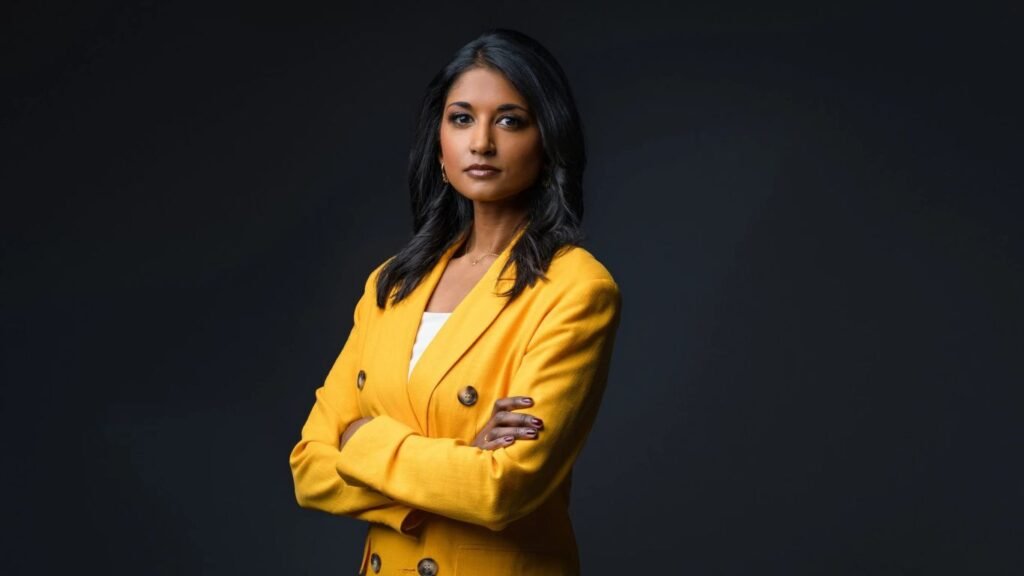
Sumi Somaskanda made a name for herself working in the areas where different languages, countries, and political systems meet. A lot of people know her from her work as an anchor on BBC News from Washington, D.C. She has a calm voice that works well for elections, wars, international crises, and breaking news. But she didn’t start her job on a global stage, and it didn’t go in the direction of a TV star trying to get more attention. It grew as people reported, wrote, produced, edited, and spent years explaining politics in Europe and the United States to people in more than one country.
That’s what’s interesting about Somaskanda. She is not a famous journalist whose private life is the thing that everyone knows about her. She is an international broadcaster whose name is being looked up more often since the BBC grew its U.S. news operations and put her in charge of major global stories. The best way to understand her life is to look at her work: the newsrooms, the beats she covered, the languages she spoke, the topics she came back to, and the professional image that took her from Berlin to Washington. Sumi Somaskanda is a BBC anchor and journalist.
What does Sumi Somaskanda do?
Sumi Somaskanda is an American reporter who works for BBC News as a host, reporter, editor, and interviewer. She lives in Washington, D.C., and works for the BBC as an international newsreader. She has also helped the BBC cover more United States politics. A lot of her time before she joined the BBC was spent in Berlin, where she worked for Deutsche Welle, Germany’s foreign broadcaster. She has worked in paper, on TV, on the radio, as a podcaster, in public speaking, and as a moderator for live events.
Somaskanda is better known for her work in international news than for a single interview that went viral or a moment that made the news. Her public record shows that she has been a reporter who has written about politics, immigrants, the economy, cyber security, fake news, democracy, and issues between the US and Europe. That range is important because she has worked on many stories that need background information rather than quick reactions. She is known for making complicated political events easy to understand without taking away from how important they are.
The first question that many people ask is simple: why is she on BBC News? Where did she come from? The answer starts in the US, goes through local and regional journalism, gets more in-depth in Berlin, and ends in Washington, DC, with one of the most well-known news organisations in the world. Somaskanda’s career shows that polished anchoring is often the last thing that people see of a much longer working life. There is a reporter behind the desk who has spent years studying how institutions, voters, governments, and public trust change when things get tough.
Early life and family history
Few reliable facts are known about Sumi Somaskanda’s early family life. She hasn’t made her personal life a big part of how people see her, and most of her professional biographies are about her work in education, languages, news, and broadcasting. That makes it hard to give accurate information about her parents, siblings, childhood home, or early family effects, which is what a responsible biography needs. One thing that can be said about her public career is that it shows she has a strong international view and is at ease moving between cultures.
One of the best ways to see that bigger picture is through Somaskanda’s language background. Her public professional profiles say that she is a native English speaker who also knows German, Spanish, and Tamil in a conversational way. The Tamil is called Sri Lankan Tamil in some profiles, but she hasn’t built her public identity around family history or personal origin stories. In journalism, language can affect access, listening, and trust. The fact that she speaks more than one language helps explain how broad her work is.
Her life story also points to an American background. Before her long time in Germany, she worked in U.S. media. When she came back to Washington, DC, she was a BBC anchor. That movement points to a career that has been shaped by both working in an American newspaper and being involved in politics in Europe. This also helps to explain why she can talk about U.S. politics with people from all over the world without treating America like a closed country.
Going to school and starting out in journalism
One of Somaskanda’s official journalism educations was at Northwestern University’s Medill School of Journalism, which is one of the most well-known journalism schools in the US. For a long time, Medill has been linked to practical reporting, clear writing, and workplace discipline. You can see these habits in the way her career has developed. She didn’t go straight into a senior role as an international host. She learned how to work in a lot of different types of media before she became a famous news anchor, which is something that many serious television journalists do.
Early job postings put her in touch with local and regional media, including radio and TV stations in the United States. During those early years, they may have done reporting, directing, anchoring, and documentary work. While local journalism may not be as well-known as global broadcasting, it teaches people how to be quick, accurate, fair, and good at breaking down news for people who don’t follow politics very closely. It’s hard to fake those habits later in life.
Before becoming well-known as an international reporter and host, she also worked as a producer. People who watch often can’t see the work that goes into producing, but it’s one of the most important skills a writer can have. The job of a producer is to teach people how to pick stories, write scripts, check facts quickly, and put together live shows. Somaskanda’s later comfort with different types of broadcasting is likely due in large part to that training behind the scenes.
Getting a Job in Different Formats
Somaskanda has never been just one type of journalist, which is one of the things that makes her career unique. In the past, she has been a reporter, news anchor, writer, editor, director, podcast host, and moderator. It’s common for media to do that these days, but in her case, the different roles seem to have helped each other rather than pulled her in different ways. Her writing made her better at analysing things, her producing made her better at making editing decisions, and her anchoring made her a guide for the public through fast-moving stories.
She has written for and been on TV and radio stations around the world that are known for covering foreign policy, politics, and global events. In her writings, she has talked about German politics, immigration issues, the rise of the far right, cyber threats, economic divides, refugee policy, and the public’s lack of trust in the media. These are not easy topics to write about, and they need stories that connect people, institutions, and history. The writings of Somaskanda show that he was a reporter who was interested in places where democracy and social change are hard to handle.
Also, this range helped her get ready for TV. Being calm and having a clear voice are not enough for an international anchor to be strong. She needs to know why a story is important, how it fits into a bigger picture, which parts are most important, and what the audience needs first. For Somaskanda, having worked in different types of journalism gave her a bigger pool of ideas to draw from.
The Berlin Years and the Beginning of Deutsche Welle
Berlin was the place where Somaskanda’s international career really took off. She lived and worked in Berlin for about 14 years, reporting and hosting during a time when Germany was at the center of some of Europe’s most important political debates. During those years, there were problems with the Eurozone and refugees, the rise of the Alternative for Germany, problems with Russia, concerns about digital safety, and new discussions about Germany’s place in the world. For a reporter, Berlin was the best place to see news from around the world and around the country.
In her time at Deutsche Welle, Somaskanda was a top host and reporter for DW News. DW is Germany’s foreign broadcaster, and its English-language service reaches people all over the world. In that way, her job was different from German programming at home. She wasn’t just explaining what was going on in Germany or Europe to people in her own country; she was also translating for people around the world who needed context, clarity, and perspective.
During her time at DW, she also regularly covered breaking news and live events around the world. When reporting foreign news, you need to be steady because stories often come in with missing details, high stakes, and effects that span borders. An anchor has to be careful not to give people false hope while still being clear about what is known. Somaskanda’s later job at the BBC was a direct result of that experience.
Writing about Germany, immigration, and democracy
Somaskanda’s written reports from Europe show that he is always interested in places where democracy is under pressure. She wrote about the big problem of refugees in Germany, the politics of asylum, fears of extremism, attacks on public media, economic anger in eastern Germany, and the rise of the far right in places where people felt like they weren’t being heard. It was important to be careful with these topics because it was easy to lump them into stereotypes. In her best stories, she told them as political, social, and personal events at the same time.
The plight of refugees was one of the most important stories in Europe during her time in Berlin. The decision by Germany to take in a lot of asylum seekers changed German politics, put institutions to the test, and became a major issue for Chancellor Angela Merkel’s government. Numbers and slogans alone would not help people from other countries understand the story. It was important to pay attention to things like schools, homes, local leaders, fears of crime, integration, and the political movements that grew in response.
Somaskanda also talked about the rise of the far right in Germany and the growing problems between the east and west of the country. Why were these stories so important? Because they showed how politics can be affected by the past. Disappointment with the economy, anger at culture, fears of migration, and mistrust of leaders all became linked. By writing about these topics, Somaskanda built a body of work that later made her especially useful for writing about American politics, where similar worries have shaped elections and public life.
I write, edit, and speak in public.
For a TV host, Somaskanda’s career is doing very well because she has written a lot of public works. She has written for Foreign Policy, The Atlantic, The Washington Post, Al Jazeera, Newsweek, USA Today, PRI, GlobalPost, and other publications. These bylines show that she did more than just read the news for TV viewers. She also reported on stories and helped shape them for readers. That is important because written news leaves behind editorial decisions that can be looked at later.
A lot of the time, her writing is about politics and public trust. She has written about fake news, online threats, doubts about the media, and growing political division. These issues have become very important to news, both as topics and as pressures on the job. A reporter who has spent years writing about information disorder can better understand why people might be sceptical, confused, or overwhelmed.
She was also an editor at the Berlin Policy Journal and the host of the podcast Studio Berlin, which talked about current events. Those jobs gave her more exposure than just daily reporting. When editing, you have to make decisions about structure, evidence, and style. When hosting a podcast, you have to make decisions about conversation, pacing, and topic command. Together, they helped Somaskanda become a journalist who can switch between different types of writing without losing sight of his main goal, which is to explain what’s going on in the world.
Going to BBC News
In 2023, Somaskanda became the chief host of BBC News, which was a big step in an already successful international career. As part of its plan to grow its U.S. news teams, the BBC said she would be based in Washington, D.C. When she was hired, the BBC was putting more focus on coverage in North America and adding more shows from Washington, D.C. At the time, she was close to the middle of one of the most-watched political stories in the world: the US is about to hold another very important presidential election.
Because of her background, the move made sense. For years, Somaskanda had been reporting on events in Europe. She also had experience anchoring global news and knew about the problems with democracy that have happened in both the US and Europe. BBC viewers, especially those outside of the U.S., see U.S. politics as more than just a story about the U.S. It has an impact on global institutions, migration, trade, wars, and alliances.
Somaskanda is the chief presenter, which means she is in charge and is seen by many people. People only see the anchor, but the job also requires editing judgement, interview prep, live coordination, and the ability to lead viewers through uncertainty. The BBC name can get you things, but it can also make people look closely at you. Somaskanda’s calm, well-informed style works well in that setting for foreign broadcasting.
American News, World News America, and U.S. Coverage of Elections
American News, World News America, and U.S. Coverage of the election – sumi somaskanda
The BBC’s coverage of U.S. politics made Somaskanda’s role in Washington stand out. She has worked with World News America, a BBC show based in Washington, D.C., that tries to explain what’s going on in the United States to people around the world. During the 2024 election cycle, the BBC added more U.S. election shows, and Somaskanda was one of the hosts who reported and hosted across platforms. People in Europe, Asia, the Middle East, and other places paid close attention to her story because of that work.
As part of her work on the election, she also wrote about voters in states that were close. This kind of reporting is important because it goes beyond campaign speeches and polls to find out what people really think about the economy, immigrants, democracy, leadership, and foreign policy. Because of her background, Somaskanda was a good fit for those talks. She had been writing about the gap between European politics at the government level and general anger for years.
She also hosted BBC audio work examining America’s relationship with the world. That kind of project shows what her role in Washington is all about. For people around the world, the election isn’t just about who wins; it’s also about what the U.S. choices mean for trade, migration, the Middle East, climate deals, NATO, China policy, and Ukraine. Somaskanda’s job has taught her how to make those connections clear without making them seem like simple answers.
Style in public and on air
People think of Somaskanda as skilled, calm, and serious. She doesn’t seem to be trying to get attention by sharing personal information, acting out on social media, or branding herself with a lot of opinions. Their appeal comes from how clear, calm, and subject-fluent she is. In a media society that likes to give out heat, she is more like the older style of anchor who acts as a guide rather than a performer.
That doesn’t mean her work is cold, though. Anchors who can sound serious without being aloof tend to get more views, and Somaskanda’s style fits in that area. She tells you what she thinks without being mean. She can talk about war, political strife, and social tension while keeping the audience on track. That is harder to do than it looks, especially these days when news breaks faster than facts can be checked.
The way she acts in public is also typical of foreign broadcasters like BBC and DW. Presenters are asked by these groups to talk to groups of people who have different political views, beliefs, and levels of background knowledge. In that role, an anchor can’t rely too much on local slang. That’s what Somaskanda does because she tells stories in easy-to-understand language while keeping the important parts of the stories.
Getting married, having kids, and living alone
Sumi Somaskanda has mostly kept her personal life quiet. Public sources that you can trust don’t make it clear if she is married, has kids, or has close family ties. Some online biography pages say they know more than others, but these claims are often based on weak sources or are made over and over again without proof. That doubt shouldn’t be turned into speculation by a responsible profile.
Journalists who write about politics and foreign issues often need this level of privacy. Many people know news anchors because of their jobs, not their personal lives, like artists, influencers, or entertainment stars. Keeping a queue can also help protect the reporter and the people around them. In the case of Somaskanda, the public record mostly points to her work life rather than her personal life.
People may still look for those things because TV makes people feel like they know them. When people see someone on TV or in films a lot, it can make them want to know more about the real person. But being curious does not lead to verified information. The truth is that Somaskanda’s family life is not well known to the public, and it looks like she has decided to keep it that way.
Sources of Income and Net Worth
The public doesn’t have a good idea of how much Sumi Somaskanda is worth. Estimates may be on some websites, but they are usually just guesses and shouldn’t be taken as facts. It’s hard to find out how much a journalist makes because it depends on their job, the place where they work, their contract, their level of experience, and any other work they do outside of work. Any exact number would be a guess without checked bank records.
We can talk about her sources of income in more general terms. Somaskanda has worked full-time as a radio journalist, writer, editor, podcast host, moderator, public speaker, and teacher. As the top presenter for BBC, it makes sense that her main source of current income would come from her job on air, though the details of her salary are kept secret. Any extra paid event work or moderation would depend on her plans and her boss’s rules.
People often look for public figures’ net worths, but these are often one of the least reliable parts of online biography culture. The most important thing about Somaskanda’s money is not a number, but the level of professional standing her roles imply. A move from senior presenter at DW to top presenter at BBC shows a long and successful career in the media. It doesn’t show personal wealth by itself.
Awards, honours, and standing in the field
Instead of a long list of well-known awards, Somaskanda’s public image is made up of important appointments and appearances in important public forums. She’s been a speaker or moderator at important policy and civic events, such as forums about truth, trust, misinformation, trade, migration, and foreign affairs. These invites show that you are a credible professional. They also show that people outside the studio know about her work.
The fact that she was chosen to be a BBC top host is a big deal in her career. The BBC is one of the most closely watched news outlets in the world, and the job of chief presenter gets a lot of attention. These kinds of appointments aren’t just for being on camera. They need editors who can be trusted, experience with live news, and the ability to speak for the company during big stories.
Her past job as a senior host on DW also shows how well-known she is in international media. DW and the BBC have viewers all over the world, so they need reporters who can deal with accents, political beliefs, and different levels of basic knowledge. Somaskanda’s work at both schools makes her one of only a few broadcasters with a lot of experience working across the Atlantic.
Problems and scrutiny from the public
Since the public can trust what they read, Sumi Somaskanda has not been involved in any big public scandals. That doesn’t mean she has never been criticised for her work, though. Public radio and TV reporters and political reporters work in places where they are closely watched. It means that there isn’t a big scandal or well-known scandal that defines her life. Her public record is mostly about her work, not her personal problems.
But the things she talks about can be controversial. People are very angry about U.S. elections, immigration, far-right politics, war, media trust, and false information. People who don’t like the way the stories are framed, the questions being asked, or the organization often criticise the journalists who cover those topics. That’s part of political journalism today, especially for news outlets that cover the whole world.
One thing that stands out is that Somaskanda’s public image hasn’t changed. Not by stirring up trouble or putting on an ideological show, she has built her brand. Her writing follows a type of journalism where credibility depends on being careful, well-researched, and able to tell the difference between fact and claim. That kind of restraint can seem very old-fashioned in today’s media, but it’s also why people look for serious broadcasters during big events.
Where Is Sumi Somaskanda Right Now?
Sumi Somaskanda is best known for being the chief host of BBC News in Washington, D.C., where she works. Her job puts her at the center of political coverage in the United States for people around the world. She is still connected to BBC shows that talk about American politics, foreign relations, and big news stories. Her home base in Washington, D.C., is important because the U.S. capital is where most of the world’s government attention goes.
The way she is now also shows how the news has changed in a bigger way. More and more, international broadcasters need reporters who can work in digital video, podcasts, social media, live events, and the field. Somaskanda’s journey has already crossed those formats. That makes her a perfect fit for the BBC’s efforts to reach viewers who don’t get their news in just one way.
The truth is that her life story is still being written right now. She went from learning a lot in Berlin to using what she learned in Washington, D.C., during a very unstable time in American and world politics. The next phase of her career will likely be shaped by the same themes that have defined the earlier one: democracy, trust, migration, power, and the task of explaining complex events clearly.
Questions People Ask Often
What does Sumi Somaskanda do?
She is an American journalist and the chief host of BBC News in Washington, D.C. She is known for bringing you foreign news and for her time as a senior host and correspondent at Deutsche Welle in Berlin. She also writes, edits, hosts podcasts, teaches, and hosts public policy events as part of her job.
Politics, immigration, the economy, fake news, internet security, and world events are some of the things she has written about. The BBC’s coverage of the U.S. has grown as it has used presenters from Washington, D.C., to explain American politics to people around the world. Some people look up to her less as a celebrity and more as a serious global reporter.
What country does Sumi Somaskanda belong to?
In most professional profiles, Sumi Somaskanda is called an American journalist. Her work, on the other hand, has been very international. She has worked in Germany for a long time, knows several languages, and has written about politics in Europe and the US for audiences around the world.
Her background as an American is especially useful for her present job at the BBC in Washington, D.C. She has a lot of experience describing European politics and also knows a lot about U.S. politics. This gives her work a transatlantic feel that fits with the BBC’s viewers around the world.
Before she worked for BBC News, where did Sumi Somaskanda work?
Somaskanda worked at Deutsche Welle, Germany’s foreign broadcaster, before she joined BBC News. It was her job to host and report for DW News, and she lived in Berlin for many years. During that time, she wrote about some of the most important stories in Europe and around the world, such as German politics, immigration, democracy, and foreign crises.
She also worked in radio, TV, print, and podcasting, and she wrote for a number of well-known publications. In the beginning of her career, she worked in local and regional media and production in the United States. That broad background helped her get ready for important jobs in international broadcasting.
Does Sumi Somaskanda have a husband?
Sumi Somaskanda hasn’t stated in public that the information about her marital status in sources that most people trust is correct. Many websites don’t have good proof that they know if she is married or not, but some of them may say they do. Because of this, her relationship status should be kept secret unless she tells everyone directly.
This privacy fits with how people see her. Somaskanda has kept the focus on news and not on getting attention for himself. Her public life is based on her work, languages, reporting, and roles in foreign media.
What kind of kids does Sumi Somaskanda have?
The public doesn’t have any solid proof that Sumi Somaskanda has kids. The majority of her professional biographies and public profiles don’t go into great detail about her family life. Claims about children should be taken with a grain of salt unless they come from a reliable source or Somaskanda herself.
A lot of people are interested in the personal lives of TV anchors they see on a daily basis, but not all of their information is open to the public. Somaskanda seems to have made a clear separation between her work life and her personal life. People should stay away from that queue.
In how much money does Sumi Somaskanda have?
Sumi Somaskanda’s public net worth has not been checked. When you see estimates online, you should take them as guesswork since they don’t usually come from solid financial records. Personal finances of journalists are rarely made public, and exact salary information is often kept secret.
Most likely, she makes money from her job as a senior broadcast journalist. At different points in her career, she may also have made money from writing, moderating, speaking, or teaching. But it’s not safe to say what the exact number is. Her job as a senior executive at one of the world’s top news organisations makes the claim more likely to be true.
How many languages does Sumi Somaskanda know?
Public job profiles for Sumi Somaskanda say that she speaks English as her first language and also speaks German and Spanish very well. She is also said to speak Tamil in a normal way. She used those language skills for her job in the US, Germany, and international news.
Language skills are important in news because they affect who can read, listen, and understand other cultures. Somaskanda’s ability to speak more than one language probably helped her report better in Europe and make it easier for her to talk to people from all over the world. This is one reason why her work has such a clear international feel to it.
In conclusion
Sumi Somaskanda’s life story is not like the stories of famous people who are built around shows. It’s the story of a writer who became well-known by consistently working in different countries, styles, and on tough topics. Early jobs in a newsroom led to reporting in Berlin. She then went from DW News to the BBC and from covering European politics to covering world events in Washington, D.C. Each step built on the authority that people now see on TV.
The fact that her interests haven’t changed makes her work stand out. She has moved from one newsroom to another writing about migration, democracy, trust, fake news, public institutions, and how politics in one country can have effects on other countries. She has written about these topics, spoken about them, edited them, and moderated them. That wide range gives her work depth, so it’s interesting even without public drama.
Her private life stays private, and that’s part of how people see her in public. The facts that can be checked are strong enough: an American journalist who speaks more than one language, a long career in Berlin, a senior position at DW News, and a job as the head host of BBC in Washington, D.C. These facts tell us something important about professional ethics and looking at things from a global perspective.
Now, Somaskanda is important because the world needs reporters who can see how events fit together without making them seem too simple. Her work doesn’t stay in one place, and neither do the stories she writes about. As world news gets more frequent and loud, her value lies in her steady work of helping viewers understand what they already know, why it matters, and how it affects more than just the place where the story started.