
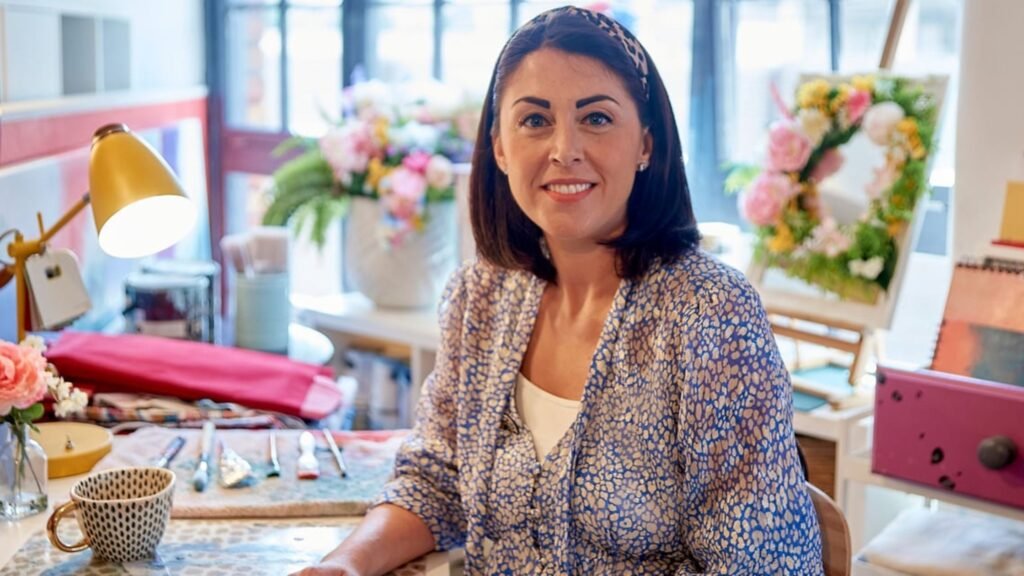
Gemma Longworth is best known to TV viewers as the smart, useful, and hands-on upcycler from Find It, Fix It, Flog It. But her story goes much further than a workshop bench. She is an artist, furniture restorer, host, author, and creative wellbeing practitioner from Liverpool. Her career started with textiles, grief support, hospital workshops, and the idea that making something by hand can help people feel more like themselves again. Her work is a natural blend of two worlds that don’t often come together: the world of used furniture and the world of repair.
The main reason people look for Gemma Longworth is because they have seen her on TV and want to know more about her. A fuller answer is more interesting than a short TV bio. Longworth became well-known for upcycling and decorating, but her creative identity was formed by the death of a family member, official art training, community workshops, and a long-term dedication to using craft as a way to boost confidence, remember things, and heal.
Early life and family history
Gemma Longworth is from Liverpool, which is still a big part of her work and public life. From her early schooling to her later workshops, studio work, and bigger public projects, her career has been closely linked to Merseyside’s creative community. Lots of people have talked about her in terms of Liverpool’s independent arts scene, not just as someone who went on TV after a normal media career.
One of the most important things about her childhood is that her younger brother died. Interviews with the public have tied that loss to her choice to use drawing, textiles, and art as ways to deal with her grief. Longworth said that her brother loved drawing and that making art to remember him helped her understand how creativity could make her feel before it became her job.
Craft practices from her childhood also show how her family affected them. People who wrote about her early business have said that she learned creative habits like knitting and drawing from her older relatives. These specifics are important because Longworth’s later work isn’t shown as an overnight lifestyle brand. It grew from everyday, hands-on making that turned into formal study, business, TV, and therapeutic practice.
Schooling and Early Creative Goals
Longworth’s education took a very creative road. She went to school in Liverpool to study art and design. After that, she did more work in applied arts, drawing, textiles, and creative therapy. The classes she took not only helped her improve the technical side of her work, but they also taught her how to see art as something that could help people through hard stressful times.
She went to the City of Liverpool College after high school to learn about different art and design subjects. In the beginning, getting that kind of broad training helped someone who would later work with paint, fabric, furniture, found items, interiors, and group workshops. Longworth didn’t stick to a single narrow field; instead, she built a career by finding the places where useful making and emotional expression met.
After that, she studied drawing and applied arts and finished her graduate work in textiles. Her research was also linked to art therapy and the use of art in care situations. That interest became a big part of her career, especially when she worked with hospitals, groups that help people who have lost a loved one, and creative wellbeing groups.
Groups for art, grief, and hospital stays
This is one of the most important parts of Longworth’s life: she helped kids and families who were going through grief. She worked on artistic projects with Alder Hey Children’s Hospital in Liverpool while she was in school and after she graduated. Children who were grieving could get help from her through art, which helped them describe feelings that are hard to put into everyday language.
Because of this part of her life, her public message about craft often sounds like it’s about more than just decoration. Longworth doesn’t just make pretty things to put on a shelf or paint chairs to match the colour scheme of a place. It can also help someone remember things, ease stress, make a routine, and feel a little in charge during a hard time.
That doesn’t mean she treats craft like a magic bullet, and smart readers shouldn’t take it that way. Her work is more of an artistic support than a replacement for professional help. But here’s the thing: a guided creative session can help a lot of people feel safe enough to talk about their grief or worry without feeling judged.
What the Button Boutique Is and How to Start a Business
Longworth made her first big name for herself in business through The Button Boutique. She started this creative business because the jobs she was looking for didn’t fit with the life she wanted to build. She didn’t wait for the right part to come along; she made one herself. The Button Boutique showed her love of textiles, handmade items, vintage fashion, parties, classes, gifts, and reusing old things to make new home decor.
The business grew from craft classes and the need for creative people in the area. Longworth could use it as a base to teach, sell, try new things, and meet with people who also wanted to make things. It also showed that she could turn her art training into a business, which isn’t always easy for creative college graduates.
The Button Boutique was more than just a store concept. It was a mix of a workshop, a studio, a community space, and Longworth’s belief that people can learn to be creatively confident. During this part of her job, she learned how to talk to people who were just starting out, deal with real clients, run sessions, and make creative work feel friendly instead of scary.
Big Step Forward in Your Career on “Find It, Fix It, Flog It”
Gemma Longworth became well-known through the Channel 4 show Find It, Fix It, Flog It, which is about restoring and upcycling things, and later through wider UKTV watching. The show follows presenters and restorers as they find broken-down things in homes, barns, sheds, and lock-ups and then fix them up or find new uses for them so they can be sold. Longworth’s role made her creative eye and useful furniture skills known across the country.
On TV, she is often linked to Simon O’Brien’s part of the show, where old things are fixed up and made useful or pretty. The fun part of her job is that she can make things that are rough, unwanted, or awkward feel like they are worth saving. People can see her sanding, painting, rethinking shapes, picking finishes, and finding ways to make pieces that were given up on work again.
Television changed how well known Longworth was, but it didn’t make her skilled. She had been making art, running a business, and giving workshops for years before she got noticed by the public. That background helps to make her seem more grounded on screen; she doesn’t seem like a host trying out her craft, but more like a working maker who knows how much work goes into a good finish.
Upcycling Style and Creative Thoughts
Longworth’s style of upcycling is bright, useful, and based on reusing things. She likes the unique character of old things, especially furniture and materials that are still useful but need to be cared for, fixed, or given a whole new use. Her work often tries to meet the needs of a wide range of people while also showing her own love of colour, pattern, texture, and surfaces that say something.
One of the quiet lessons in her work is about getting ready. On TV or social media, upcycling may look easy, but the real thing takes time, cleaning, sanding, fixes, priming, careful product choices, and patience. Longworth’s method takes into account that a piece needs to look good even when the camera isn’t there; it also needs to be able to handle being touched, moved, sat on, opened, closed, and used.
People are also interested in sustainability, which fits in with her mindset. Upcycling isn’t always a good thing if it’s done wrong or makes more waste, but if you do it right, you can keep useful things out of landfills. It’s possible to give a wardrobe, chair, cabinet, or table a second life if you have the right skills and imagination, as shown by Longworth’s work.
The Project for the Sir Thomas Hotel
Longworth’s work on renovating Liverpool’s Sir Thomas Hotel was one of her most visible public projects outside of TV. She was able to use upcycling ideas on a large scale through the project, instead of just in her own home or on TV workshops. It also showed that environmentally friendly design can work in a hotel, where furniture needs to be strong enough to last for a long time.
Instead of replacing all the furniture, the hotel job involved giving the old stuff a new look. A few of the things that Longworth made were wardrobes, bedroom cabinets, dressing tables, headboards, and chairs. The goal wasn’t to make old furniture look brand new, but to bring old rooms back to life while still using good furniture.
Longworth became known as more than just a craft star with projects like these. Hospitality interiors need to be consistent, last a long time, meet schedules, and take into account how the design will make paying guests feel. Her work on the renovation of the Sir Thomas Hotel showed that her upcycling skills could be used for more than just small decorations.
Hidden Gems and Being Creatively Well
Longworth later created Hidden Gems, a creative support project that combines her skills in art, craft, upcycling, helping people who have lost a loved one, and health and wellness. The project shows the most personal theme in her work, which is the idea that being creative can help people deal with tough feelings and get back in touch with themselves. It has classes and workshops for people of all ages, abilities, and types of groups.
People are becoming more interested in creative health and social prescribing, which is a good fit for Hidden Gems. More and more people in the UK are talking about how community arts, craft, and cultural activities can help people feel less alone, improve their mental health, and find routine and connection. Longworth’s work fits right in with that movement because it is useful, friendly, and focused on doing things instead of just talking about them.
The name Hidden Gems also fits who she is in public. For her, things and people that are easy to miss are interesting. This could be an unwanted cabinet, a lost skill, or someone who is having a hard time seeing their own worth after losing someone close to them. Her work has a clear emotional center that comes from the link between fixing things and having faith in yourself.
Make Your Cure and Become an Author
Longworth’s work on creative well-being reached more people in 2025 when she published the book Craft Your Cure: 25 craft and upcycling projects to heal and bring joy. Her personal story, her love of making things, and her belief that craft can help people through hard times were all brought together in the book. It also helped people who knew her from TV understand the greater meanings behind her work.
There are craft, textile, do-it-yourself, and upcycling ideas in this book. Its goal is not only to teach a skill, but also to get people to take their time, work with their hands, and make something that means something to them. This difference is important because a lot of Longworth’s work starts with an item and ends with a feeling, like pride, calm, memory, confidence, or relief.
She changed who she was in public when she became an author. She stopped being just the woman people knew from a restoration show and started speaking out about creativity and well-being in general. The book gave shape to the ideas she had been working on for years in hospitals, community groups, through upcycling, and in her own life.
Family, Friends, and Personal Life
In public, Gemma Longworth has talked about her family in a meaningful way, especially how the death of her younger brother changed her artistic life. That story is important to know about her work because it shows how her own grief affected her later work on art, memory, and healing. It also explains why helping people who have lost a loved one has become such a big part of her public goal.
The public doesn’t have as much reliable information about her marriage, children, or relationships. Longworth hasn’t built her public image around private home exposure like some TV stars have. Most reliable public information about her is about her job, school, upcycling, creative projects, brother’s death, book, and work in the community.
Because of this, claims about a husband, partner, or children should be taken with a grain of salt unless Longworth has confirmed them in a public setting that can be trusted. An honest biography shouldn’t use guesswork to fill in blanks about private matters. We know for sure that the death of a family member affected her creative work and that much of her public work honours the emotional power of memory, connection, and care.
Sources of Income and About How Much They Are Worth
Gemma Longworth’s exact net worth is not known from any reliable public records. Any exact number going around online should only be taken as a guess unless it comes from verified accounts, government announcements, or direct confirmation. She is a working artist, not a famous person whose earnings are well known thanks to big contracts or public records.
Her sources of income seem to be TV work, reusing old furniture, interior design projects, creative workshops, public speaking, writing, and work on Hidden Gems projects. She has also run creative businesses and worked for groups in community and health settings. These streams point to a creative job with many different types of work rather than a single big source of income.
The truth is that a celebrity’s net worth isn’t always one of the best parts of their online biography. For someone like Longworth, the more useful fact about her money is not a guessed amount, but how she has made a living in a number of related areas. Her work shows how a modern creative person can have a public identity that includes craft, media, schooling, community service, writing, and design projects.
How the public sees her and why people like her
Longworth’s public image is friendly, sensible, and emotionally open without being too much. It looks like she likes the problem-solving side of things figuring out what can be saved, what can be changed, and what might surprise people when it’s all done on TV. People remember her a lot because of how warm she was.
People like her because she doesn’t think that creativity is something that only pros can do. She has taught regular people how to make, fix, and try things for a long time. That means that her work can be seen by people who may never work as a furniture restorer but still want to paint a chair, fix a cushion, join a craft group, or make something important after a hard time.
Her public character also has a strong sense of where she comes from. Longworth’s projects, language, and professional networks all show that she is from Liverpool. She’s not just connected to the city because it’s part of her background; Liverpool is an important part of the artistic community that helped shape her and continues to support a lot of her work.
Now We Know Where Gemma Longworth Is
Gemma Longworth is best known as a creative worker who works in TV, upcycling, writing, interior design, and health and wellness. Her work on Find It, Fix It, Flog It keeps her in touch with people who like fixing things up and making things that are useful. Her work on Hidden Gems and her book put her in a larger conversation about art, mental health, grief support, and living in a way that doesn’t harm the environment.
The way she acts in public now seems to combine her two main selves. One persona is the skilled upcycler, who can take things that aren’t needed and make them useful and attractive. The other type is a creative support practitioner who knows that making things can help people deal with their feelings, boost their confidence, and feel less alone.
That mix will probably shape her next chapter. As interest in used interiors, the culture of repair, and creative well-being grows, Longworth’s work fits right in. One of the things she does is craft that isn’t just nostalgic or pretty; it’s useful, personal, and linked to real life.
Questions People Ask Often
What does Gemma Longworth do?
Gemma Longworth is an artist, upcycler, TV host, author, and creative wellness practitioner who lives in Liverpool. She is best known for her work on the show Find It, Fix It, Flog It, where she helps fix up and sell things that people no longer want. She has made a living outside of TV by working with textiles, restoring furniture, running classes, working on community projects, and giving creative people support.
What does Gemma Longworth stand for?
She is best known for being on the show Find It, Fix It, Flog It, which restores and sells old things. Her viewers know her for her useful upcycling skills, bright fashion sense, and knack for making useless things useful. She’s also known for her book Craft Your Cure and the artistic work she does that focuses on health.
Where does Gemma Longworth come from?
Gemma Longworth is from Liverpool, and her work has stayed connected to the city. She went to school there, started an art business there, worked with local groups, and worked on public projects in the city. Many people who see and read her work understand it better because she is from Liverpool.
Gemma Longworth: Is she married?
Gemma Longworth’s marital situation is not widely known or confirmed in the public domain. Public sources that people can trust mostly talk about her creative work, TV career, education, family loss, upcycling projects, and wellness practice. Unless she confirms private information herself, it is more accurate to say that the public does not know if she is married or in a relationship.
Gemma Longworth, does she have kids?
The public doesn’t have any solid proof that Gemma Longworth has kids. A lot of online profile pages make claims about famous people that aren’t backed up by evidence, so this information shouldn’t be taken as fact without a reliable source. Longworth’s public image is based on her job, her family, her workshops, her work on TV, and her creative health projects.
What is the book by Gemma Longworth?
Craft Your Cure: 25 craft and upcycling projects to heal and bring joy is Gemma Longworth’s book. It combines useful craft and upcycling projects with her personal opinion that making things can help people feel better emotionally. The book has the same themes that run through her whole career: grief, creativity, memories, colour, repair, and self-confidence.
In how much money does Gemma Longworth have?
Gemma Longworth’s total net worth has not been made public. Any number you see online should only be taken as a rough guess unless it comes from solid financial records or direct proof. She makes money from a lot of artistic things, like TV, workshops, upcycling, interior design, writing, and community projects.
In conclusion
Gemma Longworth’s story isn’t just a success story for TV. It’s the story of a creative worker who made a personal loss, art training, useful skills, and helping others into a job that really hit home for them. Her public life shows that craft can be done anywhere, like on the kitchen table, in the hospital, on TV, or on a bookshelf.
Her purpose is always the same, which makes her stand out. The same idea keeps coming back to her mind whether she is fixing up furniture, teaching a group, writing about crafts, or helping people deal with loss: things that are broken or forgotten can still be valuable. People can feel the love in her work because she believes in it.
What her career has shown us about how craft is changing is also interesting. People no longer see making things as just a hobby or an extra for decoration. For many, it’s an important part of their personality, mental health, and ability to keep things going. Longworth has become a well-known British voice that brings these ideas together in a way that is clear and useful.
Gemma Longworth is still a person who is shaped by both skill and feeling, as she works in upcycling, TV, writing, and creative wellness. She is important not because she is a celebrity, but because she shows people that repair can be helpful, beautiful, and deeply human.